
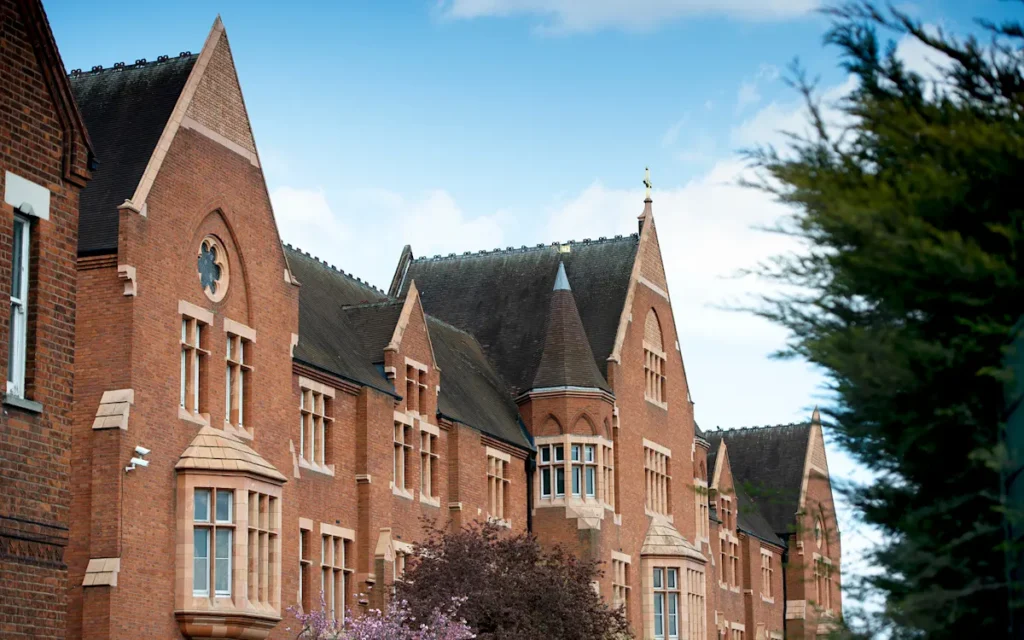
St Dunstan’s College traces its roots back to the parish of St Dunstan-in-the-East in the City of London, Shea Hollis, archivist at St Dunstan’s College, told the Lewisham Local History society.
The church, first mentioned in 1272, still stands, albeit in partial ruins, close to the Thames. It has a much longer history as a religious site, possibly originally as a Druid shrine.
The church, and much of the parish, was destroyed during the Great Fire of London and rebuilt by Christopher Wren.
The church was destroyed again by a bomb during the Blitz, which gutted the main building, but Wren’s tower survived.
Lewisham Local History Society hosts talks on the last Thursday of every month. On January 29
Dr John Price will discuss the social, cultural and community histories drawn from research into local postcards. The talk starts 7.30pm at St Dunstan’s Jubilee Pavilion, Canadian Ave, SE6 4SW
Today, the shell of a building contains a small garden and plaque linking it to the school. There has been a school associated with the St Dunstan-in-the-East parish going back to the medieval period.
Remarkably, the school has archival records that are hundreds of years old. They list some of the wealthy benefactors and parishioners who funded the school, including a Mrs Mirabelle Bennett who, in 1627, ‘gave the residue of her goods and chattels to charitable uses’ including the purchase of a plot of land in Lewisham.
By the mid-1800s, with the City of London becoming increasingly commercial, the parish trustees began looking for a location to build their new school – somewhere green and leafy, but, more importantly, close to a railway.
Mirabelle’s land, a stone’s throw from the newly opened Catford Bridge station, was the perfect spot.
“Owing to the enormous prices of London ground [and] the school should be placed at such a convenient distance from London as to be accessible by railway and that it should be therefore built on the Charity Estate at Catford Bridge in the Parish of Lewisham immediately contiguous to the Mid-Kent Line of the South Eastern Railway Co,” wrote the parish committee.
In 1867, the parish council approved the move to Catford. However, planning permissions took years, and there were delays, including a dispute over a filled-in ditch, which had been covered with asphalt without informing the trustees.
It’s believed the ditch still lies beneath the pavement along what is now Stansted Road (which, incidentally, was ‘upgraded’ from Lane to Road around the time of the school’s construction).
The school finally opened in October 1888 with 91 boys. A special train service was arranged from Charing Cross for the opening day.
Even today, the rail continue to have an important role in the school’s tradition, with pupils travelling by chartered train to attend the annual commemoration service — a longstanding event in which early benefactors, like Mirabelle, are thanked.