
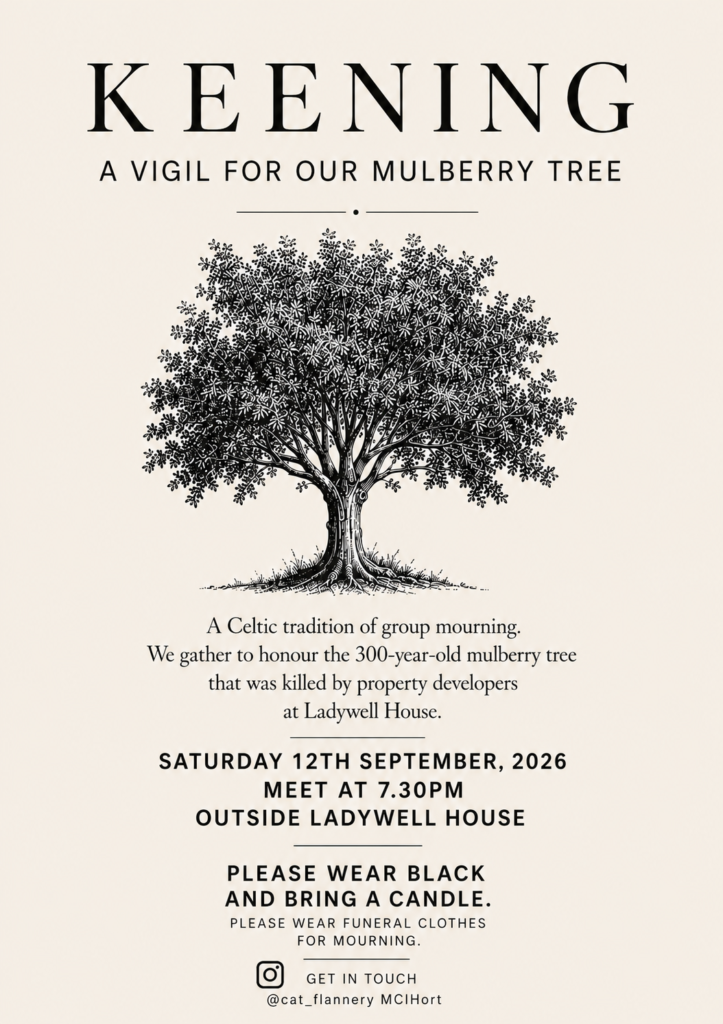

Later this year, a group of us will gather outside Ladywell House dressed in black, carrying candles, to mourn a tree.To some people, that may sound unusual. To us, it feels entirely natural, writes Cat Flannery.
The tree is the ancient Ladywell House mulberry, thought to have been planted sometime between the late 17th and 19th century, making it potentially more than 300 years old.
It has quietly witnessed generations of local life, surviving while the landscape around it changed beyond recognition. Research by Peter Coles through the Morus Londinium project has uncovered the remarkable history of this tree and the former vicarage gardens it once anchored.
Earlier this year, following extensive pruning during development work, the tree suffered catastrophic damage. Despite being protected, what remains today is little more than a stump, prompting widespread concern from local residents and the Ladywell Society.
Our gathering is not a protest. It is a vigil.
Across many cultures there is a long tradition of coming together to mourn collectively. In Ireland and Scotland this was known as keening: communities gathering to sing, cry and honour a life that had been lost. We rarely make space for grief in public anymore, yet perhaps we should.
Trees are more than landscape features. They hold memory. They outlive us. They shade generations of children, feed wildlife, mark celebrations and quietly witness our everyday lives. When an ancient tree disappears, we lose more than timber. We lose a living piece of our shared history.

The vigil has been organised by local residents, tree lovers and members of the community who believe that acknowledging loss matters.
We’ll gather simply: dressed in black, with candles in hand, sharing a few words beneath the evening sky. There are no speeches of blame or political banners. Just a chance to recognise that this old mulberry mattered.
People sometimes ask whether anyone has done this before.
Around the world there have been ceremonies marking the loss of forests after wildfires, memorial plantings following devastating storms, and community gatherings for beloved landmark trees. But they remain surprisingly rare. Perhaps that’s because we still struggle to recognise that environmental grief is real.
We’re obsessed with planting trees for the cameras, while quietly allowing ancient ones to be felled. Conservation starts by protecting what we already have.”
As the climate crisis deepens and mature trees become increasingly precious, maybe mourning them is not so strange after all.
Perhaps it is simply another way of saying: this mattered.